

The NBA has faced growing criticism across the first three weeks of the season after referees repeatedly failed to whistle obvious traveling violations by stars including LaMelo Ball and Giannis Antetokounmpo.
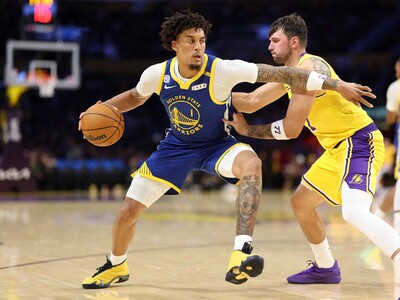
The controversy deepened after Golden State Warriors guard Stephen Curry was penalized for a harsh traveling violation during a tight 116-113 loss to the Phoenix Suns last week. The rare whistle highlighted the league's uneven standards, coming during a stretch where far more blatant extra steps were ignored and celebrated across American television broadcasts as routine highlights.
Several high-profile plays have drawn ridicule since opening night. Milwaukee Bucks forward Giannis Antetokounmpo crossed half the court without dribbling once, while Caleb Wilson and Oklahoma City Thunder guard Shai Gilgeous-Alexander also went unpenalized on clear extra steps. Minnesota Timberwolves guard LaMelo Ball caused the biggest stir after taking four to six shuffle steps before making a three-pointer on October 21 in Miami.
Outrage Over Uncalled Traveling Violations
The surge in uncalled infractions has become the defining trend of the autumn 2026 season alongside early injuries. Bastien Fontanieu, publication director of the specialized basketball website TrashTalk, said that while unwhistled traveling understandably shocks fans, viewers at home have the advantage of judging plays with 4K slow-motion replays from their couches.
Former France national team center Frederic Weis, now an analyst for beIN SPORTS covering the NBA and EuroLeague, voiced deep frustration over the trend. Weis said a play like Ball's hurt his eyes, warning that offensive players now gain an unfair advantage over defenders. He warned that the league promotes viral highlights over the rules of the sport, urging officials to tighten enforcement and restore balance.

Longtime European followers of North American basketball share that disgust. Jean-Patrick Nourricier, the 44-year-old president of the French fan association Spurs Nations France, said supporters have suffered these atrocities for a decade. Nourricier said the issue has grown increasingly blatant, adding that it sickens him to see basketball dirtied in that way. The public uproar over Ball's play eventually prompted the official NBA Referees Association to respond on social media, where the group acknowledged that the sequence was an illegal four-step action.
The Introduction of the Gather Step
The current confusion dates back to 2019, when the NBA formally adopted the gather step, or zero step, following a decade of informal tolerance. The rule allows a running player an additional foot strike while gaining full control of the ball at the end of a dribble, before taking the standard two steps toward the basket.
The rule also enabled players to execute double step-backs to create space from defenders before shooting, because the initial foot plants while securing the ball are excluded from the step count. Offense quickly surged, while traveling whistles plummeted across the league.
During the 2021-2022 season, NBA referees called an all-time low average of just 1.26 traveling violations per game. After facing ridicule, officiating rebounded the following season to average 3.4 traveling calls per game.
That temporary crackdown included a late 2022 game between the New York Knicks and the Cleveland Cavaliers that featured 13 traveling whistles, a single-game record since March 2007. Cleveland head coach J.B. Bickerstaff conceded after that game that every match should be officiated with that rigor, but noted that because they are not, players and coaches struggle to know where they stand. The NBA has since stopped addressing the issue, ceasing all publication of traveling whistle statistics over the past three years.

European Impact and French League Controversy
The debate extends beyond the United States, raising concerns among fans that the credibility of stars like Victor Wembanyama and Luka Doncic depends on regular-season officiating aligning with the playoffs. In Europe, domestic competitions face the same dilemmas over offensive footwork.
The defining moment of the French Betclic Elite season arrived on October 4, when Paris Basketball guard Nadir Hifi hit a game-winning three-pointer to secure a 103-101 victory at Le Mans. The shot divided opinion, hailed as brilliant by admirers but condemned as an illegal travel by critics due to Hifi's signature supersonic step-back.
French international referee Yohan Rosso said public reaction celebrated the beauty of Hifi's shot rather than criticizing officiating, apart from social media comments. Rosso explained that referees try to whistle traveling only when an extra step impacts the game, noting that basketball remains entertainment.
Player Confusion and Officiating Numbers
The gather step era continues to produce confusion among players and coaching staffs despite preseason meetings in the Betclic Elite. Weis noted that active players tell him they do not understand the rule and simply do their best. Weis admitted he has mistakenly called travels during live broadcasts because the rule is so hard to grasp, questioning how basketball can reverse course now that three-to-four-step moves are normalized for entertainment.
Rosso pointed out that nine years after Europe adopted the zero step, players constantly test its limits, pushing their step-backs to the edge of legality. Rosso said officials must focus heavily on foot placement and prepare with video scouting, because catching such subtle footwork live is exceedingly difficult.
The speed of modern players has sparked debate over officiating crew sizes. Fontanieu said that while traveling does not endanger basketball, player technique has never been higher and foot speed has doubled. He questioned why the sport still relies on three-man officiating crews just as it did in the 1990s, asking whether leagues should expand to six referees to see everything on the court.
Rosso disagreed, insisting that the three-referee system remains completely suited to basketball in 2026. He argued that three officials provide all necessary angles, supported by instant replay to review contentious plays, leaving referees to watch the feet of Ball and other master manipulators of the zero step.