
Niki Lauda suffered severe burns and critical lung damage when his Ferrari caught fire during the German Grand Prix at Nürburgring on August 1, 1976. Forty-two days later, still bleeding inside a modified helmet, he was racing again.
The crash
The accident happened on the second lap. Lauda's Ferrari 312T2 left the track before the Bergwerk corner, hit a barrier at an estimated 190 kilometres per hour, and burst into flames. The car rebounded onto the circuit, where it was struck by other vehicles. Lauda was trapped in the burning cockpit. His helmet had come off in the collision, leaving part of his head and face exposed directly to the fire.
Four drivers stopped and ran into the flames. Brett Lunger, Guy Edwards, and Harald Ertl arrived first. Arturo Merzario, a former Ferrari driver, reached the wreck shortly after. The first attempts to free Lauda failed because he was still strapped in. Merzario, who knew Ferrari's seat-belt mechanism, leaned into the burning car and released the belts. The four drivers pulled Lauda clear.
The injuries
Lauda sustained serious burns to his head, face, and hands, lost part of his right ear, and required skin grafts. Surgeons rebuilt his eyelids using skin taken from his ears. But the burns, as Lauda said years later, could be treated. What nearly killed him was the damage to his lungs. For dozens of seconds he had inhaled smoke and toxic gases from the burning fuel, tyres, and bodywork. His condition deteriorated rapidly. He was airlifted to hospital and fell into a coma. Doctors were uncertain he would survive the night. A priest was called to administer the last rites.
In a 1977 BBC interview, Lauda described what he could recall. The head injury had erased the final minutes before the crash and roughly 20 minutes after it. What he remembered was the struggle in the hospital. He said he was exhausted and wanted to sleep, but was aware that what was pulling at him was not simply tiredness. He described his effort as keeping his mind active and his body willing to fight. He did not present his survival as a miracle. He said he had to cooperate with the doctors, endure painful treatment, and refuse to give in.
A circuit Lauda had tried to cancel
The Nürburgring's old Nordschleife layout was already considered one of the most dangerous circuits in the world. It ran for more than 22 kilometres through the Eifel mountains, with more than 170 corners. Jackie Stewart had called it the Green Hell. Because of its length, it was practically impossible to position adequate rescue crews and fire equipment at every section of track. Weather conditions could also differ sharply from one part of the circuit to another.
Lauda had raised these concerns that same morning. He gathered the drivers and proposed the Grand Prix should not go ahead, arguing that safety measures were inadequate. The proposal was put to a vote, rejected, and the race started as planned.
Back in six weeks
Once the immediate danger had passed, Lauda set himself a goal his team considered unimaginable: to return to racing before the season ended. He had lost weight, the wounds on his head had not healed, and his face remained heavily scarred. Ferrari personnel who saw him in early test sessions said he looked like a ghost.
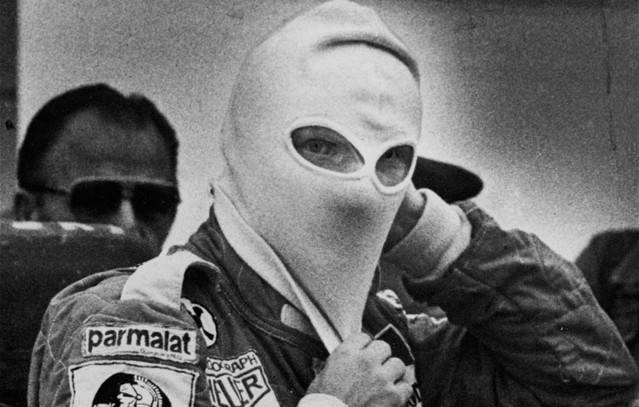
He appeared at the Italian Grand Prix at Monza on September 12, 1976, just 42 days after the accident. He had missed only two races. His helmet had been modified to reduce pressure on the wounds, but friction still caused bleeding. When he removed the helmet, the bandages were soaked in blood.
Lauda later admitted he had been rigid with fear at Monza. He drove anyway, completed the race, and was classified fourth.
He remained in the championship fight until the final round, at Fuji in Japan. Racing in heavy rain, with his eyesight still affected by his injuries, he withdrew after two laps, having judged the conditions too dangerous. James Hunt finished third and took the championship by a single point. The decision drew criticism. Lauda said he was not prepared to risk his life again.
The title, one year later
In 1977, Lauda won his second world championship. On July 31 of that year, 364 days after the accident, he won the German Grand Prix at Hockenheim. He had not returned merely to race. He had returned to win.
The facial scars remained visible for the rest of his life, as did the lasting effects of the toxic gases he had inhaled. Lauda consistently avoided framing his story in terms of heroism. As he described it, he had acknowledged the fear, weighed the risk, and gone back when he judged he could manage it. The crash had not made him fearless. It had shown he could continue despite being afraid.


