
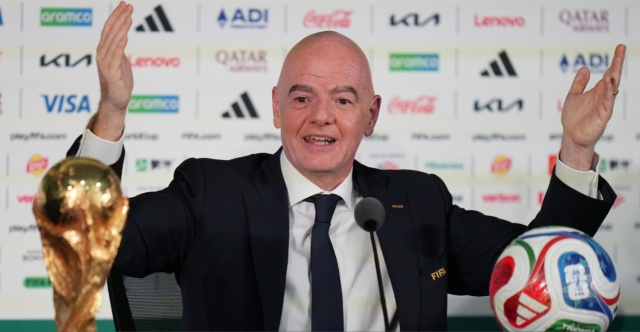
FIFA president Gianni Infantino has abandoned a plan to sell stakes in the governing body's flagship tournaments to private investors, saying the proposal produced division when the aim had always been to unite and improve world football. Infantino announced the withdrawal in a statement to Sky News.
The plan would have asked FIFA's 211 national federations to approve private investment in top FIFA competitions, including the Men's and Women's World Cups. Each federation was offered $40 million in financial support as an inducement.
Infantino said his intention going forward was to bring all interested parties back together in the coming days and weeks, guided by the common interest of the game and with a goal of continuing to develop football everywhere, particularly in countries that most need support.
Confederations and governments push back
The reaction to the proposal was immediate and extensive. UEFA voted unanimously to boycott FIFA tournaments if the plan proceeded. Concacaf announced that its member federations had rejected the proposal, with sources saying a majority of federations in the region had lost confidence in Infantino. The Asian Football Confederation aligned itself with UEFA and Concacaf, expressing solidarity with both bodies.
Political opposition came from the highest level. British Prime Minister Andy Burnham publicly called for Infantino's resignation, describing him as the wrong man to lead FIFA.
Internal opposition at FIFA
Dissent also came from within the organisation itself. FIFA's chief operating officer, Kevin Lamoure, accused the leadership of a lack of transparency and claimed that even FIFA's own management had been deceived about how the proposal was designed and put together.
On the same day, Carlos Cordeiro, Infantino's senior adviser on strategy and governance, resigned from his role. Cordeiro described the proposal as a bad deal for football that would mortgage the future of the sport.
Fourth-term bid under pressure
Infantino, 56, now faces the gravest crisis of his presidency. The FIFA Congress is scheduled for March, at which he is seeking a fourth term in office. The breadth and speed of the opposition has left him significantly weakened inside the organisation he leads.
After withdrawing the plan, Infantino said he intended to bring all stakeholders back to the same table, in the spirit of the common interest of the game.
World Cup expansion still on the agenda
Infantino's retreat on private investment does not close the wider debate over the tournament's future. According to a document seen by Reuters, FIFA plans to commission an independent body to study the impact of expanding the 2030 World Cup from 48 to 64 teams. The 2030 edition marks the centenary of the first World Cup.
The 64-team proposal was submitted by the South American Football Confederation, CONMEBOL, with the aim of allowing more nations to take part in the centenary celebrations.
The 2030 World Cup will be co-hosted by Morocco, Portugal and Spain. To mark the centenary, Argentina, Paraguay and Uruguay will each host one match.
The 2026 World Cup, held across the United States, Canada and Mexico, was already the largest in the competition's history, with 48 teams competing for the first time instead of 32, across a schedule of 104 matches.