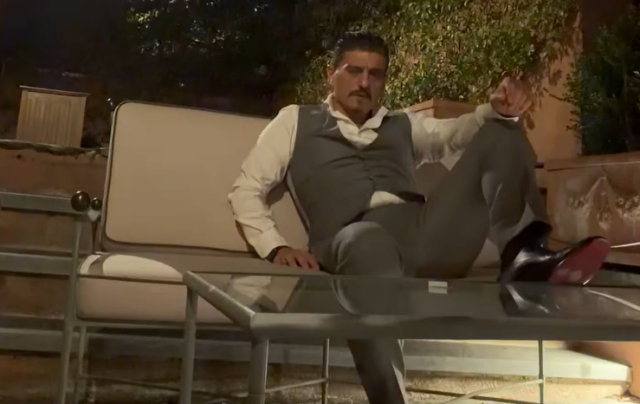


Former National Basketball Association player Royce White has set a ten-business-day deadline for the Women's National Basketball Association to clarify his eligibility after formally declaring for the 2027 draft as a transgender woman.
White, a first-round selection in the 2012 NBA draft, submitted an official declaration to the women's league earlier this month asserting his eligibility under the identity of a woman named Roycha. Subsequent reports have indicated that the league considers him ineligible to play.

Speaking to The Daily Mail, White confirmed that his team submitted formal documentation to the league office but has not yet received an official reply.
"The official communication that we sent to the league informed them that I was declaring for the draft - or declaring myself eligible in the league. No, we've not had any official communication back," White said. "We gave them 10 business days to respond in terms of letting us know about my eligibility, so that 10 days isn't even up yet."

White criticized American institutional culture while explaining his decision to seek entry into the women's basketball league.
"We are still in the throes of highly polarized political and ideologically captured institutions in this country, and the WNBA is one of them," White said. "As a beautiful black trans queen, I just want them to keep to their standards when it comes to Roycha, Roycha's dreams, Roycha's aspirations, and Roycha's desire to be included and respected. I have a right to exist."

Growing cultural friction over WNBA draft rules
White's declaration comes during a period of major commercial success for the WNBA, marked by soaring television ratings and arena attendance, alongside rising political friction over gender identity policy on the sidelines.
Tensions escalated after Indiana Fever guard Sophie Cunningham told ESPN that she wanted to protect young girls in locker rooms and sports from biological men. Her remarks triggered demonstrations outside basketball arenas nationwide and established Cunningham as one of the most widely discussed players in the league.

The draft debate expanded when former NBA center Enes Kanter Freedom declared for the 2027 WNBA draft shortly before White. Freedom subsequently attended a WNBA game wearing a shirt displaying the definition of a woman, leading to a confrontation with Chicago Sky guard Natasha Cloud. Cloud had to be held back by staff before security escorted Freedom out of the arena.

White commented on the treatment of Freedom at the game, describing the reaction from league officials and security as excessive.
"I thought they overreacted in how they treated him," White said. "It was a very minor clash, and to me, it just underlined the politicization of what's going on."
Parallel draft bids and Kentucky recruitment
Despite pursuing parallel public challenges to WNBA draft regulations, White clarified that he and Freedom are not operating in tandem.
The two former NBA players have never spoken, despite a near-miss fifteen years ago when head coach John Calipari recruited both athletes to the University of Kentucky.
"We run in different circles, and that's fine. I'm sure our paths will cross, but I'm not seeking a bromance alliance," White said. "But hats off to him, and I hope he gets drafted. The league needs to stick to its standards or make them clear."

NBA draft history and mental health dispute
White was selected 16th overall by the Houston Rockets in the 2012 NBA draft out of Iowa State University. However, his NBA tenure was cut short during a dispute over mental health protocols and his generalized anxiety disorder, which included a severe fear of flying.
White maintains that public accounts obscured the true nature of his departure, asserting that he authored the mental health policies later adopted by the league.
"The information is so bad in our country that people actually think I'm not playing in the NBA today solely because I couldn't fly on airplanes," White said. "In 2012, the NBA didn't have a single mention of mental health in their entire collective bargaining agreement. I actually wrote the policy they put in place. The policy currently in place for the NBA regarding mental health came out of my personal notebook."

White stated that league executives pushed him out after disagreement over his public insistence on establishing player healthcare standards.
"The NBA and I had a huge argument about mental health policy," White said. "Their doctors agreed with me that there needed to be a policy, but they disagreed that I should be the one forcing the issue because it put them on the spot. In the offseason, I was pushed out of the league - or blackballed, for lack of a better term."
Following his time in the NBA, White played in the NBA G League, competed in the BIG3 three-on-three basketball league, and fought as a heavyweight mixed martial artist in MMA.

Political campaigns and economic arguments
White subsequently transitioned into politics, mounting campaigns for the U.S. House of Representatives before winning the Minnesota Republican Party endorsement for the U.S. Senate in 2024. He finished third in a narrow loss in this year's Republican Senate primary and has announced a run for President of the United States in 2028.
White noted that current and former NBA players have offered him private support following his WNBA declaration.
"There's a wink and a nod. People say, 'You're right. Keep going, keep doing what you're doing,'" White said. "A lot of players message me saying, 'What are we even talking about, from a basketball standpoint?'"
White described his WNBA bid as part of a wider culture war, pointing to public stances taken by team coaches. He cited Minnesota Lynx head coach Cheryl Reeve wearing a thematic T-shirt and comments made by the head coach of the Golden State Valkyries.
"The Lynx coach is a good example - she wore the T-shirt. The Valkyries coach made comments about it," White said. "They could have said, 'No comment.' They commented because they feel passionately about it. It just so happens a lot of people in this country disagree with their opinion."
White also put forward an economic case for allowing male-assigned athletes into the women's league, suggesting high-profile players would drive commercial revenue.
"If LeBron James played in the WNBA, it would help the WNBA. I honestly mean that," White said. "It would help money-wise, revenue-wise, and exposure-wise. It would help get more eyes on the game. You could make an economic argument that letting people assigned male at birth play in the WNBA would actually help the game."

Scrutiny of WNBA Commissioner Cathy Engelbert
White directed criticism toward WNBA Commissioner Cathy Engelbert regarding her public silence on draft eligibility rules.
"It's white privilege," White said. "That's heteronormative white privilege is what it is. I've seen stories about other issues where she's been scrutinized. I think this is a pretty clear-cut issue, and obviously she's struggling with it. I don't like scapegoats."
He suggested that institutional pressure from the NBA influences decision-making at the women's league level.
"The political pressure on her is either a widespread cultural thing or coming from above," White said. "I'd love to hear what the NBA has to say - they've been quiet on the whole matter, but we all know they're footing the bill for the league."
White concluded by calling on the WNBA to clearly state its criteria for female eligibility.
"The WNBA is as popular as it's ever been," White said. "If the WNBA is saying I'm ineligible, why wouldn't they want me in the league? That's the question people should ask Cathy: if Royce White identifies as a woman and is willing to play, why wouldn't you want her in your league?"
"Hopefully, they do the right thing and either clearly define the criteria of what a woman is and say I don't meet it, or just let me play and we'll have a blast," White concluded.